The 12 Best Photography Locations (Ranked)
 #1
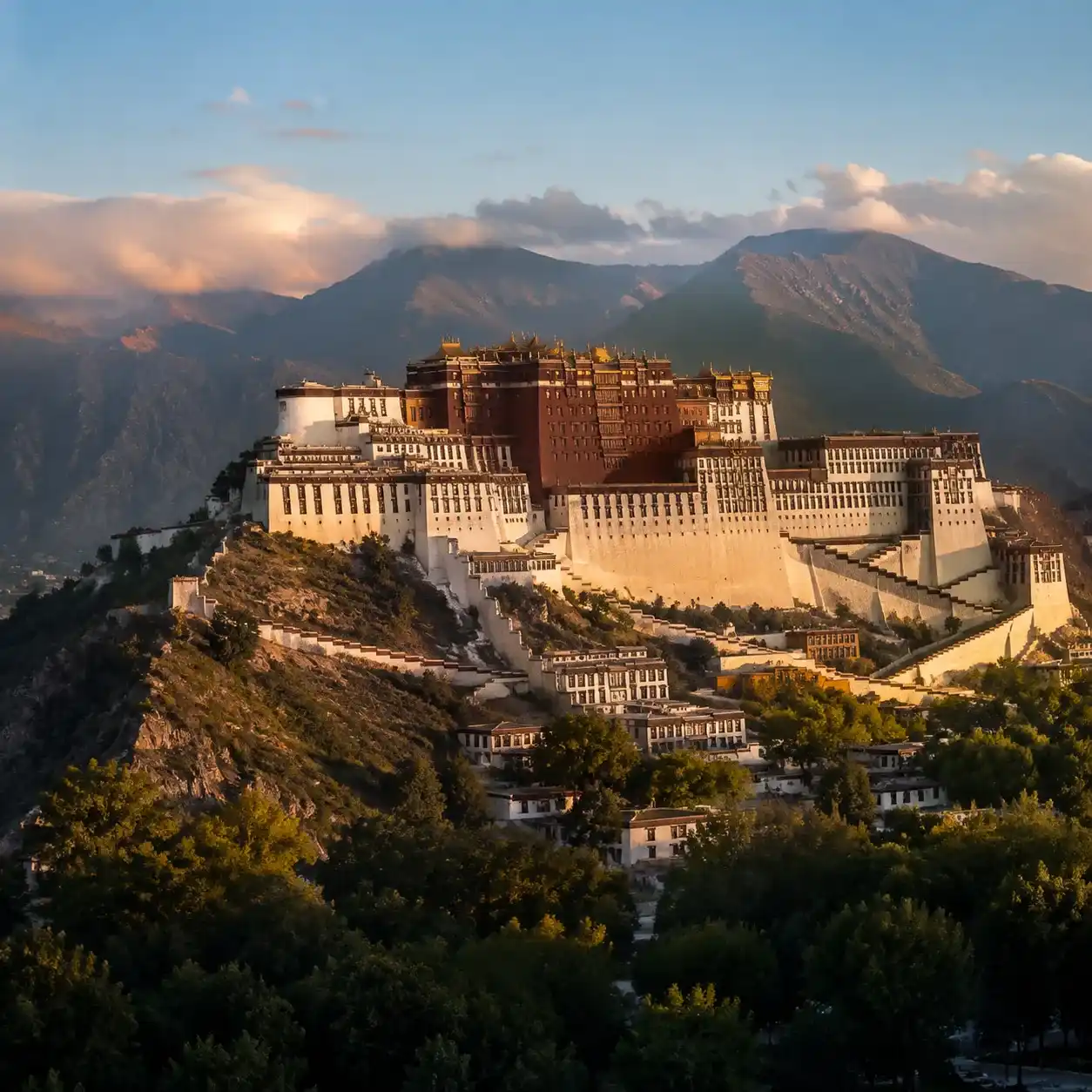
#1Chakpori Hill Summit
SunriseThe classic postcard shot. Clean, unobstructed view of the entire palace with the Lhasa valley behind. Best time: sunrise. The first rays hitting the red and white walls create a warm, golden glow that no filter can replicate.
Access: South entrance, CNY 2, 10-minute climb.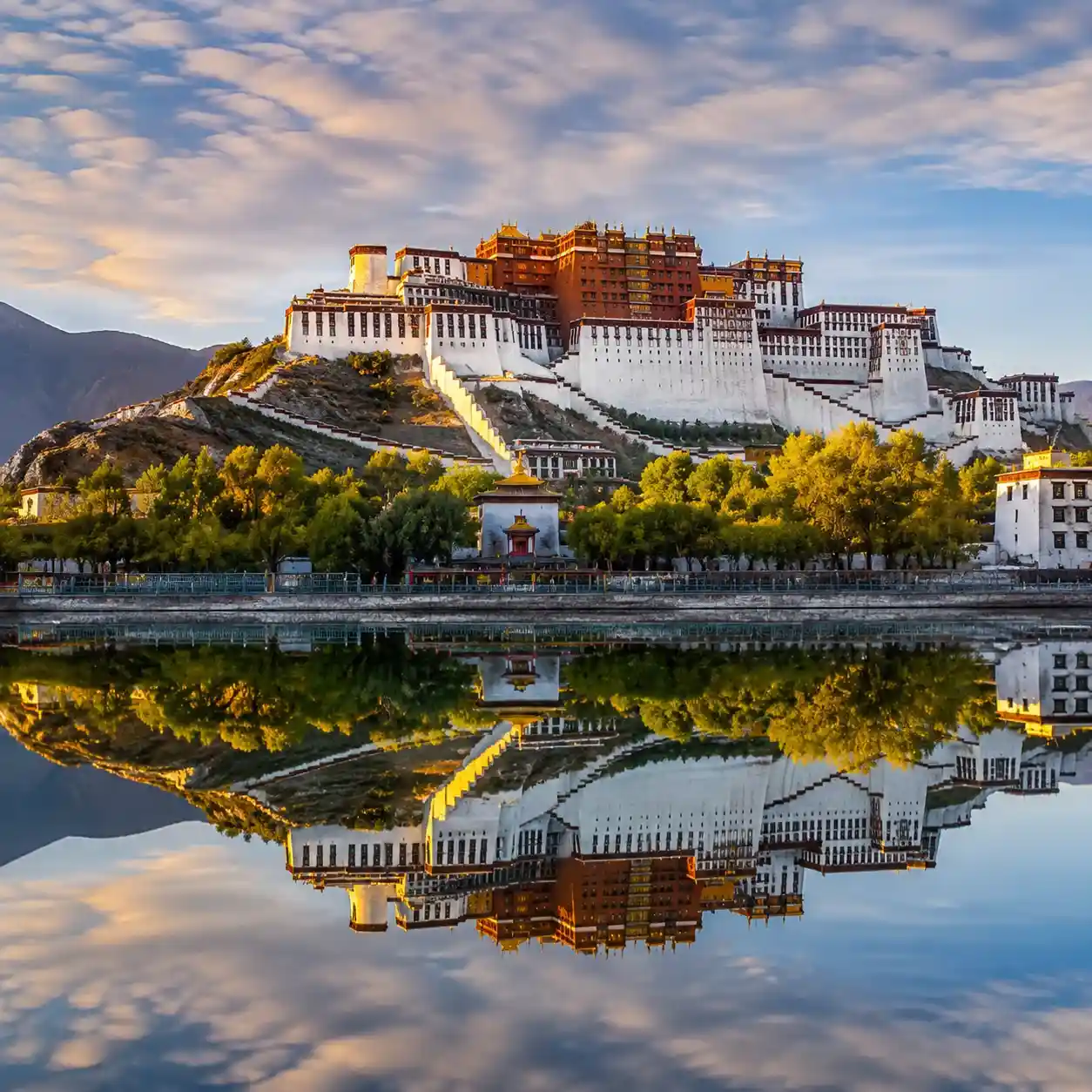 #2
#2Dragon King Pond (Longwangtan)
Early MorningBehind the palace on the north side. The best reflection shots in Lhasa. On a calm morning, the palace mirrors perfectly in the still water. This is the only angle where you can capture the full width of the palace in a single frame.
Best time: Early morning (7:00-8:30 AM) for still water and soft light.Potala Palace Square
The main plaza directly in front. Best for wide-angle panoramas and people-in-frame scale shots. Best time: Morning for front lighting, evening blue hour when the palace is illuminated. The square gets busy by 10 AM.
Yaowang Mountain Platform
An elevated viewing platform on the southwest side, offering a distinct angled perspective that shows the palace's depth against the mountains. Less crowded than Chakpori Hill. Best time: Late afternoon for warm side lighting.
Norbulingka Road
For an urban-context shot, this road runs southwest of the palace. Frame the palace through trees and street elements for a more documentary feel. Best time: Golden hour before sunset.
Lhasa River Bridge
A distant perspective with the river in the foreground. The palace appears as a distant silhouette against the hills. Best time: Sunset for dramatic silhouettes and colored sky.
An elevated city-plus-palace perspective. Requires hotel access or rooftop bar access. Best time: Blue hour for illuminated palace against twilight sky.
The palace peeking between traditional Tibetan buildings creates a powerful sense of place. Best time: Late afternoon when the alleyways fill with golden light.
A distant, framed view across the old city. The golden Jokhang roofs in the foreground with Potala on the horizon. Best time: Late afternoon.
The exit walk from the palace offers a unique perspective looking back up at the western face. Best time: Mid to late afternoon.
Local neighborhood context with the palace in the background. Less touristic, more authentic. Best time: Morning for local street life.
Use the white stupa as foreground framing for the palace. Creates a classic Tibetan composition with strong depth. Best time: Afternoon or blue hour.
"At this altitude, the light is different. Thinner air means sharper shadows. Your sensor will see things your eyes barely register."
Camera Settings for High Altitude
At 3,700 meters, the air is thinner and UV radiation is significantly stronger. Your camera will perceive more contrast than your eyes do, and exposures that look correct on your LCD may be underexposed.
ISO 100-200, aperture f/8-f/11 for architectural detail, shutter 1/125 or faster if handholding
Essential at this altitude. It cuts atmospheric haze, deepens the blue sky, and reduces glare on the golden roofs
Start at +0.3 to +0.7 EV in bright conditions. The bright sky at altitude can fool your meter into underexposing
Daylight (5500K) works well. For sunrise/sunset, try Cloudy (6000K) or manually dial to 6500-7000K for warmer tones
For high-contrast scenes (bright sky + dark palace shadows), bracket 3 shots at -1, 0, +1 EV and merge later
Lens Recommendations
For the palace against the dramatic Tibetan sky, interior courtyards, and the Potala Square panorama
Your workhorse. Covers most exterior compositions and detail shots
For isolating architectural details, compressing the palace against the mountains, and candid shots of pilgrims
Fun for creative angles but easy to overuse. The palace's symmetry works well with ultra-wide perspectives from the square
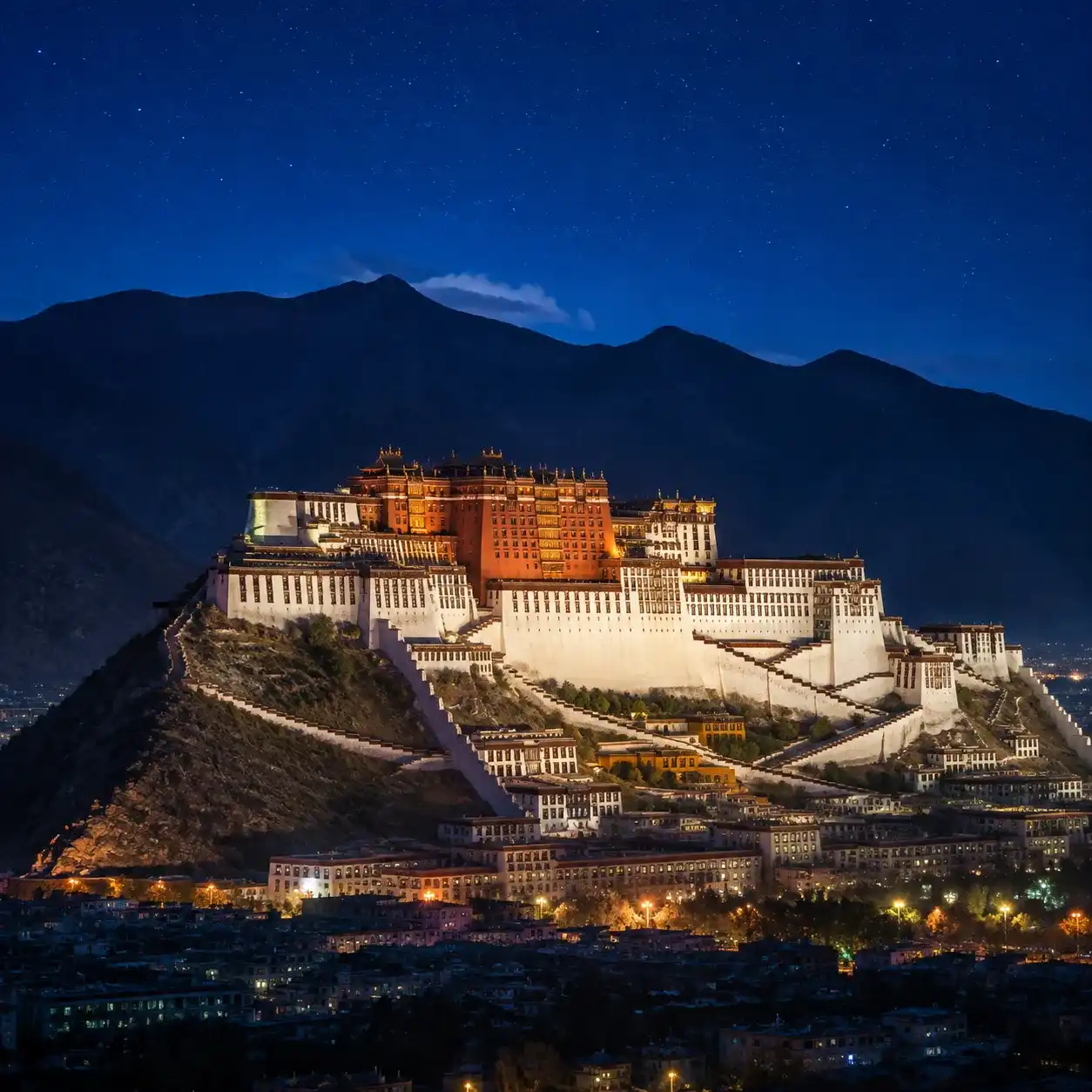 The palace illuminated after dark — a tripod is essential for night shots
Night Photography
The palace is illuminated from sunset until approximately 11:00 PM. The floodlights create dramatic contrast against the dark sky. Setup: tripod (essential), ISO 100-200, f/8-f/11, exposures between 2-15 seconds. For star trails above the palace (winter nights are clearest), stack multiple 30-second exposures at f/4, ISO 1600.
Drones are strictly prohibited in Lhasa city, especially around Potala Palace and government buildings. Confiscation and fines are likely. Do not attempt it.
Seasonal Conditions
Clear skies, moderate haze. Good all-around conditions. The landscape is green after spring rains.
Monsoon afternoons bring dramatic clouds and occasional rainbows. Mornings are often clear. The most dramatic skies of the year.
The golden window. Crystal-clear skies, golden foliage, and the best light of the year. Low haze. Ideal for every type of shot.
Snow-dusted palace views that are genuinely rare and beautiful. Clear, cold air means minimal haze. The low sun angle creates long shadows all day.
Phone Photography Tips
If you are shooting with a smartphone rather than a dedicated camera, you can still capture excellent images with the right approach. Modern phones (iPhone 14 or later, Samsung Galaxy S23 or later, Google Pixel 7 or later) have sensors capable of producing publication-quality images in good light.
Shoot in RAW or ProRAW mode if your phone supports it — the extra dynamic range is crucial for scenes with bright white palace walls against deep blue sky.
Use the telephoto lens (2x-3x optical zoom) for architectural details like golden roof finials and window carvings.
For the classic panorama from Chakpori Hill, use the wide-angle lens but watch for lens distortion at the edges — keep the palace centered.
At night, use a small tripod or rest your phone on a stable surface and use Night mode (2-3 second exposure).
Shoot in the golden hour (the hour before sunset) when the warm light on the white walls creates natural color contrast that phone sensors handle well.
Use HDR mode outdoors to handle the bright sky; tap to focus on the palace and slide down to slightly underexpose, which preserves highlight detail on the white walls; for low-light interior shots (where allowed), brace against a wall or railing; shoot in RAW if your phone supports it for more editing flexibility later.